
Veterans Jobs
Veterans Preference - Work For Uncle Sam
Federal Jobs for Veterans
Jobs for Veterans | Federal Jobs for US Veterans
There are many federal jobs available for veterans through civil service employment programs. Veterans Preference, discussed in this section, and the Veterans Readjustment Act (VRA) are two of the better known programs. Unknown to many, dependents and spouses of active duty personnel receive hiring preference for government jobs under the Military Spouse Preference program and the Family Member Preference Program.

The federal government has an outstanding record of employing veterans. Veterans hold a far higher percentage of jobs in the federal government than they do in private industry. In large part, this is due to laws providing Veterans’ Preference and special appointing authorities for veterans, as well as the fact that agencies recognize that hiring veterans is just good business. Most federal agencies, including all Presidential Cabinet-level agencies, have established a Veterans Employment Program Office responsible for enhancing employment opportunities for veterans within their agency.
According to an OPM report the Federal Government hired approximately 221,000 new employees in 2015. A total of 72,000 of the new hires were veterans, of which 31,000 were disabled veterans. The FY 2015 32.5 percent new hire rate for veterans represents an 8.5 percent increase from FY09, when the rate was 24 percent.
Veterans’ Preference gives eligible veterans preference in appointment over many other applicants. Veterans’ Preference applies to virtually all new appointments in the Competitive Service and many in the Excepted Service. Veterans’ Preference does not guarantee veterans jobs and it does not apply to internal agency actions such as promotions, transfers, reassignments, and reinstatements. Not all veterans receive preference for federal civilian employment, and not all active duty service qualifies for Veterans’ Preference. Only veterans discharged or released from active duty in the Armed Forces under honorable conditions are eligible for these veterans jobs through Veterans Preference. If you are interested in searching for available federal jobs for veterans please use the links below.

Veterans Preference Menu
- Veterans Preference (continued)
- VRA Veterans Recruitment Appointments
- Military to Federal Career – The Transition – How, What & When
- Jobs Update
- Veteran Job Listings – All occupations, sectors, and areas
- Disabled Veterans (Hiring Programs)
- Veterans Employment Opportunities Act (VEOA)
- Veterans Discrimination Complaints
- Health Care Jobs – Jobs with the VA, DOD, HHS, & DOJ
 Clearance Jobs Career Center – Matches job seekers that hold active or current security clearances to hiring employers and recruiters looking for skilled cleared candidates.
- Additional Resources
- Vet Guide
- Operation Job Search: A Guide for Military Veterans (Recommended)
Veterans Preference Continued

This means preference eligibles must have been discharged under an honorable or general discharge. If you are a “retired member of the Armed Forces,” you are not included in the definition of preference eligible unless you are a disabled veteran, or you retired below the rank of major or its equivalent.
Generally when you apply to a Federal position there are two separate referral lists:
- External – with applicants who are not Federal employees. If there are a few veterans on this list the supervisor cannot select a non-veteran. If the agency is using a point system, the 5 or 10 points is added to the overall point total assigned to the applicant. Often higher qualified applicants are not “within reach” on this list.
- Internal – with applicants who are current or prior Federal employees. On the internal list, there is no veterans’ preference. All applicants compete on a level playing field based on resume, past performance, interviews or other relevant criteria.
There are two types of preference eligibles: those with a service-connected disability (formerly titled 10 point preference) and those without (formerly titled 5 point preference). Under hiring reform the point system is being replaced with a category rating system. Until hiring reform is fully implemented you may encounter the old terminology of 5 and 10 point preference. Preference eligibles are divided into four basic groups as follows:
- CPS – Disability rating of 30% or more (10 points)
- CP – Disability rating of at least 10% but less than 30% (10 points)
- XP – Disability rating less than 10% (10 points)
- TP – Preference eligibles with no disability rating (5 points)
When agencies used a numerical rating and ranking system to determine the best qualified applicants for a position, an additional 5 or 10 points were added to the numerical score of qualified preference eligible veterans.
The category rating system places preference eligibles who have a compensable service connected disability of 10 percent or more (CPS, CP) at the top of the highest category on the referral list (except for scientific or professional positions at the GS-9 level or higher). XP and TP preference eligibles are placed above non-preference eligibles within their assigned category.
Vets Without a Service Connected Disability — (Five Point Preference)
If your active duty service meets any of the following, and you do not have a disability rating from the Department of Veterans Affairs (VA) of 10% or more, you have preference. This preference entitles you to be hired before a non-veteran whose application is rated in your same category. To meet this criterion, your service must meet one of the following conditions:
- 180 or more consecutive days, any part of which occurred during the period beginning September 11, 2001 and ending on a future date prescribed by Presidential proclamation or law as the last date of Operation Iraqi Freedom, OR
- Between August 2, 1990 and January 2, 1992, OR
- 180 or more consecutive days, any part of which occurred after January 31, 1955 and before October 15, 1976.
- In a war, campaign or expedition for which a campaign badge has been authorized or between April 28, 1952 and July 1, 1955.
Vets with a Service Connected Disability — (Ten-Point Preference)
You are a 10 point preference eligible if you served at any time, and you:
- Have a service connected disability
- Received a Purple Heart (Purple Heart recipients are awarded the same preference category as those with a service-connected disability)
- Are the spouse, widow, widower, or mother of a deceased or disabled veteran (derived preference)
When applying for federal jobs, eligible veterans should claim preference on their application or résumé. Applicants claiming disability, 10-point preference, must complete form SF-15, Application for 10-Point Veteran Preference. Veterans who are still in the service may be granted five points tentative preference on the basis of information contained in their applications, but they must produce a DD Form 214 prior to appointment to document their entitlement to preference.
Note: Reservist who are separated from the reserves but don’t currently receive retired pay aren’t considered “retired military” for purposes of veterans’ preference. If you are not sure of your preference eligibility, visit the following OPM websites:
You can also contact the designated veterans’ hiring program coordinator for your agency of interest; agency coordinator contact information can be found at the end of chapter 7 in The Book of U.S. Government Jobs.
A preference eligible who is passed over on a list of eligibles is entitled, upon request, to a copy of the agency’s reasons for the pass-over and the examining office’s response.
If the preference eligible is a 30 percent or more disabled veteran, the agency must notify the veteran and OPM of the proposed pass-over. The veteran has 15 days from the date of notification to respond to OPM. OPM then decides whether to approve the pass-over based on all the facts available and notifies the agency and the veteran.
NOTE: Entitlement to veterans’ preference does not guarantee a job. There are many ways an agency can fill a vacancy other than by appointment from a list of eligibles. For more information on this subject and to learn how to apply pick up a copy of The Book of U.S. Government Jobs, 11th edition at your local bookstore or check out a copy from your local library.
Veterans Employment Opportunities Act (VEOA)
The Veterans Employment Opportunities Act (VEOA) gives veterans access to federal job opportunities that might otherwise be closed to them. The law re-quires that:
- Agencies allow eligible veterans to compete for vacancies advertised under the agency’s merit promotion procedures when the agency is seeking applications from individuals outside its own workforce.
- All merit promotion announcements open to applicants outside an agency’s workforce include a statement that these eligible veterans may apply.
The law also establishes a new redress system for preference eligibles and makes it a prohibited personnel practice for an agency to knowingly take or fail to take a personnel action if that action or failure to act would violate a statutory or regulatory veterans’ preference requirement.
This authority permits an agency to appoint an eligible veteran who has applied under an agency merit promotion announcement that is open to candidates outside the agency.
To be eligible a candidate must be a preference eligible or a veteran separated after three years or more of continuous active service performed under honorable conditions.
Those with derived preference are also eligible for VEOA. There is not a requirement to select a VEOA applicant over another applicant as in a VRA appointment to an external announcement. Another difference is that there is no requirement for the positions applied for to be lower than a GS-11 as there is under VRA criteria.
Terms and conditions of employment
Veterans receiving a VEOA appointment will be given a career or career conditional appointment in the competitive service. Veterans interested in applying under this authority should seek out agency merit promotion announcements open to candidates outside the agency. There is no advantage for veterans with career status or reinstatement eligibility to apply under VEOA, because they already have the eligibility to apply to merit promotion announcements and there is no preferential treatment for those applying under VEOA.
Veterans Discrimination Complaints
The Uniformed Services Employment and Reemployment Rights Act of 1994 (USERRA) prohibits discrimination in employment, retention, promotion, or any benefit of employment based on your uniformed service. The Department of Labor, through the VETS, assists all persons having USERRA claims.
If you are a disabled veteran and you believe an agency discriminated against you in employment because of your disability, you may file a disability discrimination complaint with the offending agency under regulations administered by the Equal Employment Opportunity Commission (EEOC).
Resources
- Vet Guide (OPM Publication)
- FedsHireVets (OPM Vets Web Site)
- Operation Job Search by John Henry Weiss
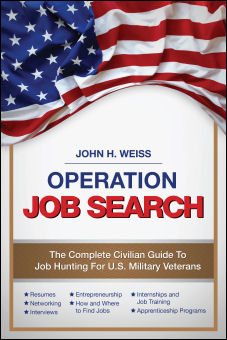
Available at bookstores & on Amazon.com